In 2026, the smartphone sits at the center of everyday life, and the mobile app market is experiencing its second — and far more powerful — golden age. The average user spends over 4 hours a day inside apps, which creates a massive space to build profitable digital businesses. If you think you need a computer science degree and hundreds of thousands of dollars for a development team to launch your own app, I've got a game-changing piece of news for you: in 2026, mobile apps are built using No-Code and Low-Code. With tools like FlutterFlow and Bubble, you can create a professional product that lands on the App Store and Google Play without writing a single line of code. This is the democratization of technology — and it's opening the door to anyone with a creative idea.
But building the app is only 20% of the job. The real game is played in the arena of monetization and App Store Optimization (ASO). Plenty of genuinely great apps fade into obscurity because their creators didn't know how to stand out among millions of competitors. In this article, we'll walk through the entire journey: from validating your idea (so you don't waste months on something nobody wants), through building with AI assistance, all the way to advanced monetization strategies — from subscriptions to microtransactions. I'll show you how to build a passive income machine that earns in dollars while you're busy doing something else. Because on the internet, your app is a tiny employee who never goes on vacation.
Making money from apps is a natural next step for anyone who's already explored building websites or is drawn to no-code automation. It's the highest form of digital craft.
1. Idea & Validation: Don't Build a Ghost App
The biggest mistake beginners make is falling in love with their own idea without checking the market first. In 2026, you don't build a "complete" app from day one. You build an MVP — Minimum Viable Product. Your app needs to solve one specific problem. If you want to create a dog training app, first check Google Trends and niche forums to see whether people genuinely struggle with this and what features they find missing in existing solutions.
Use tools like ChatGPT to analyze the competition. Ask the AI to list the weaknesses of the most popular apps in your niche, based on reviews from Google Play. That's exactly where your competitive edge lies. Remember: people don't buy apps — they buy a better version of themselves or time saved. If your app promises "better sleep" or "faster tax filing," you might be sitting on a goldmine.
ℹ️ Hottest App Niches of 2026:
- AI Micro-SaaS: Small AI-powered tools (e.g. email grammar correctors, diet generators).
- Health & Wellness: Mental health, niche meditation, habit tracking.
- Education (EdTech): Micro-learning, niche language learning, prep for specific exams.
- Utilities: Home automation tools, crypto finance management.
2. No-Code Revolution: How to Build an App Without Coding
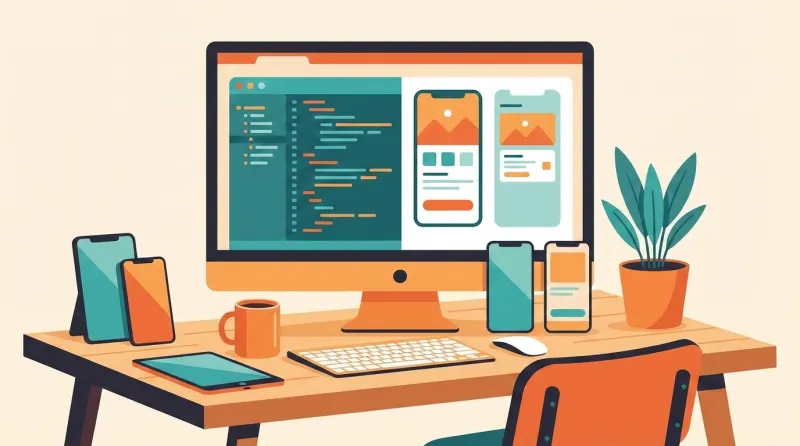
Forget about learning C++ or Swift from scratch. In 2026, the standard for independent creators (Indie Hackers) is FlutterFlow. It's a powerful tool that lets you "click together" the interface and logic of your app, then export production-ready code in Google's Flutter language with a single button. The result? Your app runs perfectly on both iPhones and Android devices.
Other important tools include Adalo (for simple marketplace-style apps) and Glide (if your app is mostly data-driven from Google Sheets). By combining FlutterFlow + Firebase (database) + ChatGPT API, you can build a sophisticated application in just 2–4 weeks of evening work. That's a 90% reduction in production time compared to traditional development. Being "non-technical" stopped being an excuse a long time ago.
If you're serious about going native, frameworks like React Native and Flutter (with Dart), or the platform-specific Swift (iOS) and Kotlin (Android), are worth learning further down the road. But for your first product, no-code gets you to market months sooner.

3. Monetization Models: How to Squeeze Profit from Downloads
You've got an app, people are downloading it… now what? Download numbers alone don't pay the bills. You need to pick a monetization strategy that won't push users away while keeping a steady stream of revenue coming in.
| Monetization model | Advantage | Disadvantage | Earnings (estimate) |
|---|---|---|---|
| Subscriptions (SaaS) | Stable, predictable income | Requires ongoing updates | $$$ (Highest LTV) |
| Ads (AdMob, Unity Ads, AppLovin) | Free for the user | Requires huge scale (millions of users) | $ (Low revenue per user) |
| In-App Purchases (IAP) | Quick gratification for the player | Risk of "pay-to-win" reputation | $$ (High volume) |
| Freemium model | Low barrier to entry | Hard to convert to Premium | $$ (Balanced) |
| Paid app | Money upfront | Users don't like paying blind | $ (Only for Pro niches) |
💰 The King of Monetization: In-App Subscriptions
In 2026, the most lucrative model is weekly or monthly subscriptions with a free trial (3–7 days). Users are comfortable paying $4.99–$14.99/month for real value. If your app has 1,000 active subscribers at $9.99/month, you're looking at $9,990 in recurring monthly revenue (minus the Apple/Google cut). That's genuine financial freedom — handled through Apple In-App Purchase, Google Play Billing, or a tool like RevenueCat that bridges both stores.

4. ASO: How to Break Through in the App Store?
ASO (App Store Optimization) is SEO for apps. Without optimization, your app will sit at the bottom of search results forever. You need to work your keywords into the title, subtitle, and the dedicated "keywords" field (in the App Store). But in 2026, the most important ranking factors are Ratings and Conversion Rate (the percentage of store page visitors who actually install the app).
The next big lever is your Screenshots. Don't upload bland UI views. Upload sales graphics that highlight a concrete benefit in the headline (e.g. "Lose 10 lbs in 30 days" over the app interface). Run A/B tests on your icon — switching the color from blue to orange has been known to boost downloads by 20% with zero ad spend.
On the US and UK markets, pay close attention to review velocity. Ask users for a rating at the right moment — right after a positive experience inside the app. A consistent stream of 5-star reviews tells the algorithm your app is actively loved, not just installed.

5. Legal Matters: Taxes, Schedule C, and VAT
Earning from apps is a global business. Your "employer" is effectively Apple (Ireland/USA) or Google (USA). That comes with some specific tax obligations you need to know about — ignore them and you could lose a significant chunk of your revenue on day one.
🔴 Legal & Tax (VERY IMPORTANT)
US creators: App income is self-employment income. Report it on Schedule C of your federal tax return. If you earn $400 or more from self-employment, you must file. Platforms issue a 1099-K once you hit $600 in payments (threshold lowered from 2023 onwards). Keep track of all business expenses — they're deductible. UK creators: Register for HMRC self-assessment if your trading income exceeds the £1,000 trading allowance. The personal allowance sits at £12,570; above that, income tax kicks in. Consider registering for VAT if your turnover exceeds £90,000. Use an accountant who understands digital products — the rules around B2C digital services in the EU can catch people off guard.
If you're selling subscriptions globally through Apple or Google, the platforms handle VAT/GST collection in most jurisdictions — but you should verify this for your specific situation with a tax professional. Use modern accounting services that understand the specifics of the IT and e-commerce space. It's money well spent.
6. Scaling: From One App to a Product Portfolio
Very few indie developers sustain themselves on a single application. Real success is built through an "App Portfolio". Once you've mastered the build process in FlutterFlow, creating your next app will take half the time. With 5–10 smaller apps across different niches, you diversify your risk against trend shifts or algorithm changes in any one store.
You can also scale through localization. Your English-language app reaches perhaps 400 million native speakers. Add Spanish and Portuguese — and you suddenly have access to hundreds of millions of users across Latin America at minimal cost (just translating the text). In 2026, localization is the cheapest route to a 5x revenue increase.
Another smart angle: build once, sell twice. If your app has strong utility, consider publishing it on Steam or the Microsoft Store alongside mobile. Desktop users often have higher willingness to pay, and the additional distribution costs you almost nothing.
Action Plan: Your App in the Store in 30 Days
Stop dreaming, start building. Here's what to do over the next month:
Days 1–5: Research and MVP
Find your niche. Write down 3 core features. Create a simple interface sketch (Figma or even pen and paper). Focus on solving one problem.
Days 6–20: Build in FlutterFlow
Connect the interface to a database (Firebase). Add logic. Use FlutterFlow's ready-made templates — don't rebuild everything from scratch. Test the app on your own phone.
Days 21–25: Monetization and ASO
Connect RevenueCat to handle subscriptions via both Apple In-App Purchase and Google Play Billing. Prepare polished screenshots for the store. Write keyword-rich descriptions.
Days 26–30: Publication
Set up developer accounts (Apple: $99/year, Google: $25 one-time). Submit the app for review. Celebrate your first install and first subscription dollar.
FAQ — Everything You Need to Know About the App Business
How much does a typical niche app earn?
A niche app with 5,000–10,000 active users can generate $500–$2,000/month from subscriptions. Top-performing no-code apps built by solo creators can hit $20,000–$50,000/month in MRR (Monthly Recurring Revenue). The range is wide — niche, pricing, and ASO make all the difference.
Do Apple and Google really take 30%?
Not for small developers! The App Store Small Business Program charges only 15% commission as long as your revenue stays under $1 million USD per year. Google Play has a similar program. That's a very fair rate for access to billions of customers' payment methods — already on file, one tap away.
What if I have zero budget for marketing?
Use TikTok and Instagram Reels. Document your build process (this is called "Building in Public"). One viral video can deliver 50,000 free installs overnight. It's the most powerful marketing method available to indie developers in 2026 — and it costs nothing but time.
Do I need an expensive Mac?
For building in FlutterFlow — no, any laptop with a browser works fine. However, publishing to the App Store does require macOS access at the final step. You can use a cloud Mac service like MacInCloud for around $20/month instead of buying hardware outright.
Summary: Your Digital Money Factory
📋 App Business Mastery — 10 Golden Rules
- Solve a problem: A cool app isn't enough — it needs to be genuinely useful.
- No-code is your superpower: Build 10x faster and cheaper than the competition.
- Subscriptions are king: Aim for recurring revenue, not one-off purchases.
- ASO is oxygen: Tend to your keywords and screenshots constantly.
- Know your tax obligations: Schedule C (US) or HMRC self-assessment (UK) — don't ignore them.
- Build in Public: Grow your audience before launch day.
- Localization is scale: Go global as fast as you can.
- Firebase is the standard: Learn modern cloud databases.
- A/B test everything: Change the icon, price, and headlines to keep growing.
- Start with an MVP: Your first version can be rough — it just needs to work.
Making money from mobile apps in 2026 is one of the most exciting paths to financial independence available right now. You build a product once, and it works for you around the world, 24 hours a day. The no-code revolution has removed almost every technical barrier — the only thing standing between you and your first dollar is imagination and consistency. The digital world is hungry for fresh, well-targeted solutions. Your app could be the one that changes thousands of people's lives. Stop being just a consumer. Start being a creator. The market is waiting for your launch.
Comments (0)
No comments yet. Be the first!
Add a comment