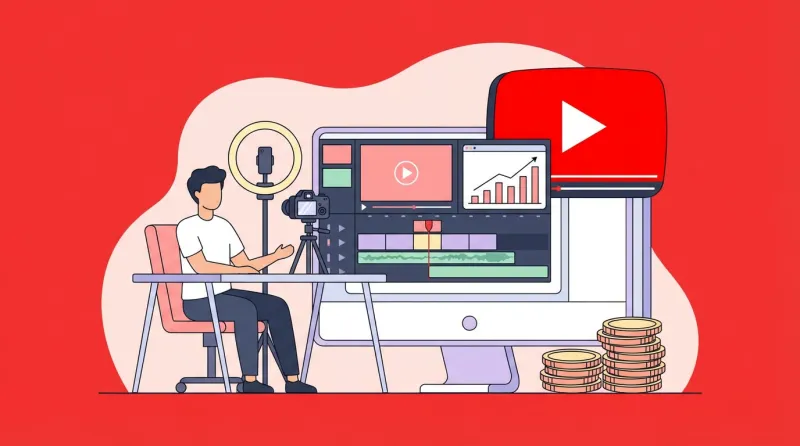
Honestly? If you think the YouTube train left the station years ago and there is no point jumping on now, you are badly mistaken. Paradoxically, YouTube in 2026 is a far more predictable and business-friendly place than it was a decade ago. Back then, success was a coin flip — one viral cat video and you were famous. Today it is applied psychology, audience math, and consistent brand-building. The competition is fierce, no question. But most people approach this so casually that if you go in with a real plan, you will outrun 90% of creators within a few months.
This guide will not sell you fairy tales about grabbing a smartphone, flashing a smile, and becoming a millionaire. I am going to talk about hard work, about exactly what behaviors the 2026 YouTube algorithm rewards, and about why "views" are actually the last number you should obsess over if you want real income. We will cover the whole journey — niche selection, gear, monetization mechanics, taxes, and everything in between. Because YouTube is not just a hobby platform. Done right, it is a business asset that works for you around the clock.
The YouTube Algorithm 2026: What Actually Matters?
The algorithm has gone through several generations. First it chased clicks (CTR). Then it shifted to Watch Time. In 2026 the system is more sophisticated still — the reigning metrics are Viewer Satisfaction and Audience Retention. YouTube no longer just wants you to click a video. It wants you to finish watching and then stay on the platform for another one — ideally from the same creator.
The biggest beginner mistake is trying to make content "for everyone." The algorithm needs clear signal data to know who to show your videos to. If you post a vacation vlog on Monday and a dishwasher repair tutorial on Thursday, the AI genuinely does not know which audience to serve. Picking a narrow, specific niche is your fastest route to growth. Better to have 1,000 loyal subscribers in the "real estate investing" niche than 100,000 random viewers drifting past your entertainment clips.
ℹ️ The KPIs That Actually Drive Growth:
- CTR (Click-Through Rate): How many people click your thumbnail. In 2026, a healthy benchmark is 6–12%.
- AVD (Average View Duration): Your average watch time. Aim for at least 50–60% of total video length.
- Returning Viewers: The most important signal of all. How many people come back for more? This is what tells the algorithm you have authority in your niche.
- Engagement: Comments and shares carry far more weight than likes. Spark a conversation in every video.
How Much Does YouTube Actually Pay? Real AdSense Earnings (RPM by Niche)
Let us talk numbers. The YouTube Partner Program (YPP) is the gateway to ad revenue. To qualify you need 1,000 subscribers plus either 4,000 public watch hours in the past 12 months or 10 million Shorts views in the past 90 days. Those are the 2024 rules still in effect. But what does approval actually earn you?
Everything revolves around RPM (Revenue Per Mille) — how much money lands in your pocket for every 1,000 video views. The number swings wildly depending on your niche and the spending power of your audience. US and UK viewers attract significantly higher advertiser bids than most other markets, which is a genuine edge for English-language creators.
| Niche / Content Type | Typical RPM (per 1,000 views) | Potential at 100K views |
|---|---|---|
| Entertainment / Pranks / Vlogs | $1 – $3 | $100 – $300 |
| Gaming / Game Reviews | $2 – $5 | $200 – $500 |
| Lifestyle / Beauty / Fitness | $4 – $8 | $400 – $800 |
| Tech Reviews / AI Tools | $8 – $15 | $800 – $1,500 |
| Finance / Investing / Business | $15 – $30 | $1,500 – $3,000 |

💰 The "Million Views" Myth
You do not need millions of views to earn serious money. A finance creator with 10,000 views on a video about mortgage refinancing can easily out-earn an entertainment vlogger with 1,000,000 views on a comedy skit. The reason is simple: advertisers pay a premium to get in front of someone actively shopping for a home loan, and almost nothing to run an ad next to a funny cat video. Niche matters more than scale — especially when you are starting out.
Gear to Get Started — Without Spending a Fortune
Do not let anyone convince you that you need a $3,000 mirrorless camera and a professional studio. In 2026, a mid-range smartphone — iPhone 13 or later, Samsung Galaxy S22 or later — shoots video that is more than good enough. Viewers will forgive imperfect visuals. They will never forgive bad audio. If your recording crackles, echoes, or hisses, people will tap away within three seconds.
💡 The Minimal Starter Pack:
- Audio: A clip-on lavalier mic like the Rode SmartLav+ (~$70) or a wireless system like the DJI Mic 2 or Rode Wireless ME for run-and-gun recording.
- Lighting: A window. Honestly. Natural daylight is the best light source available. If you record at night, one decent ring light (~$30–$60 on Amazon) or a cheap softbox makes a huge difference.
- Stabilization: A basic phone tripod costs under $20 and eliminates shaky footage immediately.
- Editing: DaVinci Resolve (free, professional-grade, PC/Mac), CapCut (free, quick mobile edits), or Descript ($24/mo) if you want AI-assisted editing and auto-captions.

YouTube Shorts: Opportunity or Trap in 2026?
Shorts are currently the fastest route to early traction. You can realistically go from zero to 1,000 subscribers in a month by publishing consistent 15–60-second vertical videos — especially if one lands on the Shorts feed. But they are a double-edged sword. Shorts viewers are notoriously non-sticky. People binge dozens of clips, hit subscribe on impulse, and then never engage with your long-form content.
The best strategy for 2026 is a Hybrid Channel. Use Shorts as a top-of-funnel discovery engine that funnels new viewers into your longer, high-value content. Do not build a channel exclusively on Shorts — ad RPMs for vertical format are still tiny (typically $0.03–$0.10 per 1,000 views). The money, the sponsorships, and the loyal community all live in long-form.
One practical approach: film your regular 10–15 minute video, then cut a punchy 45-second clip from the best moment and post it as a Short with a clear call-to-action ("full video on the channel"). That way each upload does double duty without doubling your workload.
Taxes and the Legal Side: AdSense, the IRS, and HMRC
When your channel starts earning, Google (operating as Google LLC for US creators or Google Ireland for UK) will deposit payments to your linked bank account. This is the moment you need to treat yourself like a business — because the tax authorities already will.
⚠️ Tax Obligations — Pay Attention
US creators: YouTube AdSense income is self-employment income. You will receive a 1099-NEC at year end if you earn over $600. Report it on Schedule C (sole proprietor) or through your LLC/S-Corp. Self-employment tax (15.3%) kicks in above $400 net profit. Quarterly estimated payments (Form 1040-ES) are expected once you are earning consistently — missing them triggers an underpayment penalty.
UK creators: Register for Self Assessment with HMRC once you earn more than the £1,000 trading allowance. Above £90,000 turnover you must register for VAT. Keep records of all income including Super Chats, channel memberships, and sponsorship fees — they are all taxable.
Both countries: keep a separate bank account for creator income from day one. It makes bookkeeping vastly simpler at tax time.
Creator Psychology: How Not to Burn Out After Month One
YouTube is a marathon, not a sprint. Your first 10–20 videos will likely be watched by your mum, three friends, and maybe a stranger who found you by accident. That is completely normal. The algorithm needs time to calibrate what your channel is about and who to show it to. The biggest challenge is not gear or editing skills — it is consistency.
My honest advice? Commit to the 100 Videos Rule. Promise yourself you will not judge your success or failure until you have published 100 videos. That single mental shift removes the crushing pressure of "every video has to perform." By the time you hit video 100, you will know how to speak on camera, how to cut a tight edit, and — most importantly — what your audience actually cares about. Almost nobody who publishes 100 consistent videos in a niche gives up. Almost everybody who quits does so before video 20.
Batch-recording helps enormously. Block out one weekend day and record three or four videos back to back. You are already set up, already in the zone, already in your "on camera" headspace. Then you have a buffer so a busy week does not break your publishing schedule.
Scaling Your Income: How to Earn 10x More Beyond AdSense
AdSense is a starting point, not a destination. The real money on YouTube lives in the layers beneath (and above) ad revenue. Here is how creators actually reach full-time income:
- Brand Sponsorships: A company pays you to feature their product in a dedicated segment. Rates in the US/UK market typically run $20–$50 per 1,000 views for mid-tier creators, scaling to $100+ per 1,000 views for trusted voices in premium niches. A finance channel with 50,000 subscribers can command $2,000–$5,000 per integration.
- Affiliate Marketing: Drop product links in your video descriptions. When a viewer clicks and buys, you earn a commission — typically 3–15% depending on the program. Amazon Associates, ShareASale, and Impact are the main networks. A tech review channel recommending $200 headphones with a 5% commission earns $10 per sale. Ten sales per video adds up fast. For a deeper dive, check out my guide to affiliate marketing for beginners.
- Your Own Products: Online courses, e-books, digital templates, merchandise. Margins of 70–100% versus the 3–15% you get from affiliate deals. Once you have an audience that trusts you, this becomes the most scalable income stream on the list.
- Channel Memberships: Available once you reach 500 subscribers. Members pay $4.99–$99.99/month for exclusive perks — early access, members-only live streams, custom badges, bonus content. Even 100 members at $9.99/month is $999 recurring revenue with zero production cost beyond what you are already making.
- Super Chat, Super Stickers, Super Thanks: Viewers pay to highlight their message during live streams or to pin a comment on any video. During a two-hour live stream on a finance channel, $500–$2,000 in Super Chats is not unusual if you have a loyal community.
- YouTube BrandConnect (US/UK): YouTube's own platform for connecting creators with brands. Available to US and UK Partner Program members. Brands browse your channel data and pitch deals directly — lower friction than cold outreach.
The optimal revenue mix for a sustainable creator business looks roughly like: 20–30% AdSense, 30–40% sponsorships, 20–30% own products or courses, and 10–15% memberships and live monetization. If AdSense is your only income stream, you are operating a very fragile business.
Action Plan: Your First Week on YouTube
Stop planning, start doing. Here is a seven-day framework to get your channel off the ground:
Choose Your Niche and List 50 Topics
Not one topic. Write out 50 specific questions your potential viewers are searching for answers to. These are your first 50 video ideas. Tools like TubeBuddy ($9/mo) and VidIQ ($7.50/mo) can show you real search volumes so you are not guessing.
Record Your First Video — Then Record It Again
Seriously. Record a full video, watch it back critically, note everything that feels awkward or unclear, then re-record it. That second take is your actual first publish. The confidence jump between take one and take two is remarkable.
Master Your Thumbnails
Your thumbnail is more important than the video itself. If nobody clicks, nobody watches — regardless of how good the content is. Canva has solid free YouTube thumbnail templates. Study the thumbnails on the top 10 videos in your niche and notice the patterns: face + emotion, bold contrasting text, clear focal point. Then do that.
Publish on a Schedule and Protect It
Pick a cadence you can actually maintain — one video per week is plenty to start. Publish at the same time, same day, every week. Thursday at 6 PM, Tuesday at noon, whatever works for your life. Treat it like a standing appointment. The algorithm rewards predictability, and so does your audience.
FAQ — Beginner Questions, Answered Honestly
Do I have to show my face on camera?
Not at all. "Faceless" channels — documentary-style narration, screen recordings, animation, stock footage with voiceover — are a massive trend in 2026 and some of the most profitable channels on the platform run this way. Finance explainer channels, AI tutorial channels, and true-crime narration channels routinely earn six figures without ever putting the creator on screen. Anonymity is a perfectly viable strategy.
How many videos do I need before I start earning?
The YPP threshold is 1,000 subscribers and 4,000 watch hours — not a video count. That said, most channels hit their first real traction somewhere around the 15–25 video mark, when the algorithm has enough data to understand what you make and who watches it. The watch hours requirement tends to be the harder bar: at an average view duration of 5 minutes per video, you need 48,000 total minutes watched to qualify, which takes time to accumulate.
What if someone re-uploads my video?
YouTube's Content ID system scans every upload against a database of registered content. If someone re-uploads your video, you will receive a notification. You then have three options: monetize that copy (claiming the ad revenue for yourself), block it from being watched, or track it without taking action. For most small channels, claiming the revenue is the obvious choice. Register your content with YouTube's rights management tools once you join YPP.
Should I buy subscribers or views to grow faster?
Never. Buying subscribers is the fastest way to destroy a channel. The algorithm measures what percentage of your subscribers actually watch your videos. If you have 10,000 subscribers but only 80 real viewers, YouTube reads that as a dead channel and stops recommending your content to anyone. Worse, it can trigger a review and channel termination. Every fake subscriber you buy actively hurts your organic reach. There are no shortcuts here that actually work.
Is it worth starting an English-language channel even if English is not my first language?
The financial case for English is compelling — US RPMs run 5–10x higher than most non-English markets, and the total addressable audience is dramatically larger. That said, being genuinely useful and authentic in your native language will nearly always outperform stilted English content. A better middle path: create primarily in your native language to build a loyal community faster, then explore dubbing or subtitling popular videos into English once you have content that has proven itself. Some creators also run parallel channels in two languages.
Summary: Before You Hit Record
📋 YouTube Mastery — Key Takeaways
- Niche is everything: Do not try to be relevant to everyone. Be indispensable to someone specific.
- Audio before video quality: Buy a decent microphone before you upgrade your camera. Bad sound kills channels.
- Thumbnails sell the click: The packaging sells the product. A mediocre video with a great thumbnail will outperform a great video with a bad thumbnail every time.
- AdSense is the floor, not the ceiling: Build affiliate links, a product, or a sponsorship strategy from your very first video.
- Consistency beats talent: The algorithm rewards predictable publishing schedules. A reliable creator beats a brilliant but sporadic one.
- Use Shorts for reach, long-form for revenue: Combine both formats intelligently rather than going all-in on one.
- The 100 Videos Rule: Do not evaluate your channel's potential until you have 100 videos published.
- Tax compliance from day one: Whether it is the IRS or HMRC, creator income is taxable income. Keep records, track expenses, file accurately.
- Learn your analytics: YouTube Studio will tell you exactly where viewers stop watching, where they found your video, and which thumbnails drive the best CTR. Check it weekly.
- Start today: There is no perfect moment. The second-best time to start a YouTube channel was yesterday. The best time is right now.
YouTube in 2026 is not just entertainment — it is the most powerful free marketing and publishing platform in the world, open to anyone with something worth saying. Whether you want to teach woodworking, break down quarterly earnings reports, review hiking gear, or explain machine learning concepts, your audience is already on YouTube searching for exactly that. Do not let fear of competition, fear of the camera, or fear of early low view counts stop you. The creators who win are not always the most talented — they are the ones who showed up consistently long after everyone else quit. Turn on the camera. Hit record.

Comments (0)
No comments yet. Be the first!
Add a comment