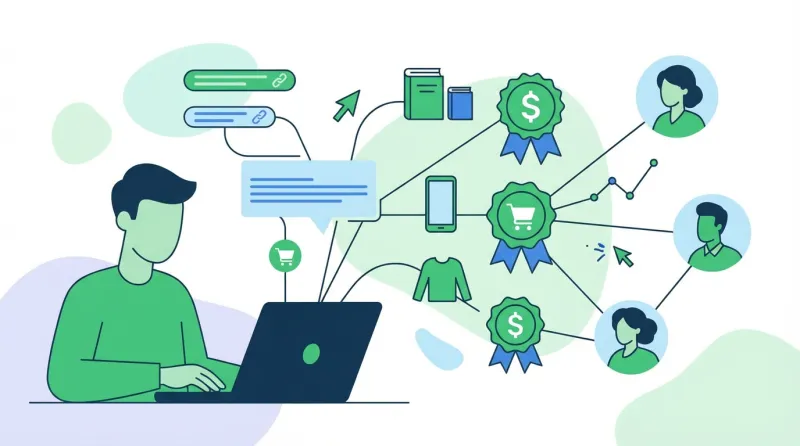
Honestly? Affiliate marketing is probably the cleanest, most straightforward form of online business that exists. You don't need your own product. You don't need to worry about inventory, shipping, or customer support. Your one job is to connect a buyer with a seller. Do that successfully — and you get a commission. Simple in theory? Absolutely. But in practice, in 2026, affiliate marketing is no longer just dropping links under Instagram posts. It's a sophisticated game of trust-building, authority, and creating systems that earn money for you while you sleep.
If you've ever wondered how your favorite YouTubers earn from "recommendations," or how laptop-ranking sites stay in business — the answer is affiliate marketing. But around 90% of people who try it quit within a month without earning a cent. Why? They treat it like a quick cash grab, not a real business. In this guide, we'll break it down to its foundations: commission models, niche selection, and how to promote links so naturally that people ask you for them.
Affiliate marketing pairs incredibly well with other online income streams — like running a blog or building a YouTube channel. Those platforms are exactly where affiliate income hits its full stride.
What is affiliate marketing and how does it actually work?
Imagine you tell a friend about a great book. They buy it, and the bookstore sends you $3 as a thank-you. That's the core idea of affiliate marketing. In the digital world, everything runs through affiliate links (or unique discount codes). Each link contains your personal identifier. When someone clicks it, a small file called a cookie gets stored on their device. That cookie tells the retailer's system: "Hey, this customer came from Sarah — pay her the commission."
One detail that matters enormously in 2026 is cookie lifetime. If you refer someone to Amazon, the cookie lasts 24 hours — meaning if they buy anything during that window, you earn. But in some programs — particularly financial services or SaaS tools — cookies can last 30, 60, or even 90 days. That means you can earn a commission from a purchase the customer made three months after clicking your link.
ℹ️ Affiliate commission models explained:
- CPS (Cost Per Sale): You earn a percentage of each sale. Most common in e-commerce — fashion, electronics, home goods.
- CPL (Cost Per Lead): You get paid when someone submits their contact details — for example, filling out a credit card application or signing up for a webinar.
- CPA (Cost Per Action): Commission for a specific action, such as installing an app or creating a free account.
- Recurring (Subscription): The holy grail of affiliate marketing. You earn a commission every month for as long as the referred customer keeps paying their subscription — extremely common with AI tools and SaaS platforms.

How much can you earn? Commission rates by niche in 2026
This isn't a salary job — there's no fixed paycheck. Your earnings depend on the product's margin and how aggressively a brand wants to reward affiliates. In 2026, the range is enormous, and knowing which niches pay the most is half the battle.
| Industry / Category | Typical Commission | Sales Difficulty | Earning Potential |
|---|---|---|---|
| Fashion / Clothing | 3% – 10% | Low | Moderate |
| Electronics / Gadgets | 1% – 4% | Medium | Moderate (high ticket) |
| Supplements / Fitness | 15% – 40% | Medium | High |
| Finance (credit cards, loans, insurance) | $50 – $200 per lead | High | Very high |
| Software / SaaS / AI tools | 20% – 40% (recurring) | Medium | Highest (passive) |
| Online courses / Education | 30% – 70% | Medium | Very high |
💰 The magic of recurring commissions
Picture this: you promote an email marketing tool priced at $99/month with a 30% recurring commission. If you refer just 3 new customers every month, after 12 months you have 36 active paying subscribers. Your passive monthly income? $1,069.20 — for work you did once. That's exactly why experienced affiliates obsess over subscription-based products.
Realistic numbers: most beginners earn $0–$300/month in year one. Established niche bloggers and YouTubers typically reach $1,000–$5,000/month after 12–24 months. The top 1% — with SEO moats, big email lists, and paid traffic — earn $10,000–$50,000+/month. Those outliers are real but genuinely rare.
Best affiliate networks: where to find programs
You don't need to email every brand individually. Affiliate networks act as marketplaces — join one platform and instantly access hundreds (sometimes thousands) of individual advertiser campaigns.
🔵 Top affiliate networks for US and UK publishers (2026):
- Amazon Associates: The world's largest affiliate program. Commissions are low (1%–10% depending on category), but Amazon's conversion rates are hard to beat — almost everyone already has an account.
- ShareASale / Awin: Awin owns ShareASale and is dominant in the UK. Thousands of advertisers across retail, travel, finance, and B2B. Strong reporting tools.
- Impact Radius: The go-to network for SaaS, tech, and software deals. Brands like Shopify, Canva, and Semrush run their programs here.
- CJ Affiliate (Commission Junction): One of the oldest networks — reliable, with big-name brands like Lowe's, Overstock, and J.Crew.
- ClickBank: Specialist in digital products and online courses. Commissions of 40%–75% are standard here, though product quality varies wildly — always vet what you promote.
- Rakuten Advertising: Strong presence in the US and Japan, good for lifestyle and fashion brands.
- PartnerStack: Built specifically for SaaS companies. If you're in the B2B or software space, this is where the best recurring deals live.

Psychology of affiliate sales: how to recommend without being salesy
Most beginners make the same mistake: "Buy this product, it's amazing! [LINK]." That doesn't work. In 2026, people have finely tuned spam detectors. Affiliate sales are built on trust and problem-solving, not broadcasting links.
The most effective approach is the Review or Comparison format. Instead of "buy this," show your process: "I had problem X. I tried tool A and tool B side by side. Tool B won because it has feature Y that saves me two hours a week. Here's where to check it out." See the difference? You're not selling. You're advising. Your goal is to be the helpful friend who actually knows their stuff — not a telemarketer.
Platform matters. SEO blog posts capture people already searching for a solution. YouTube comparison videos build trust through face and voice. Email newsletters convert best because subscribers opted in to hear from you. Pinterest works well for visual niches — home decor, fashion, recipes — a single pin can drive traffic for years.
💡 The "Bonus Stack" method:
Want to stand out from the 50 other affiliates promoting the same product? Offer an exclusive bonus to anyone who buys through your link — a free checklist, access to your private Discord community, or a 15-minute strategy call. People love getting something extra, and it's fully legal as long as the merchant allows it (always check the program's terms).
Legal requirements and taxes: FTC, ASA, and disclosure rules
Affiliate income is taxable income, and the rules around disclosure have teeth in both the US and UK. Getting this right isn't optional — and honestly, being transparent builds more trust with your audience anyway.
⚠️ Disclosure requirements you must follow:
United States (FTC 16 CFR Part 255): Any content containing affiliate links must include a clear, conspicuous disclosure near the link — not buried in a footer. On social media, "#ad" or "#affiliate" at the start of the post is required. The FTC has issued fines in the tens of thousands of dollars for non-compliance — don't gamble on this.
United Kingdom (ASA + CMA): Similar rules apply. Posts and videos must include "#ad" or "Ad — affiliate link" clearly visible before the audience engages with the content. "Gifted" and "gifted/affiliate" are separate designations with their own labeling requirements.
Tax — US: Affiliate networks issue a 1099-NEC if you earn $600 or more from them in a calendar year. You report this on Schedule C, and you'll owe self-employment tax (15.3%) on net profit above $400. Consider setting aside 25–30% of every commission for tax.
Tax — UK: The first £1,000/year is covered by the trading allowance — no tax, no reporting needed below that threshold. Above £1,000, you register for Self Assessment with HMRC and report affiliate income as trading income.
How to scale affiliate marketing: from first commission to full-time income
In the early months, every dollar feels like a victory. But how do you turn occasional commissions into a reliable income stream? The answer is automation and traffic systems that work without you actively pushing every day.
- Build an email list: Your most powerful long-term asset. Social media reach can vanish overnight — algorithms change, accounts get suspended. Your email list is yours. Subscribers who opt in to your recommendations convert at 3–5x the rate of cold social traffic.
- Invest in SEO: Target commercial-intent queries: "best X for Y," "X vs Y," "X review 2026." One well-ranked article can earn commissions for years with zero ongoing effort.
- Diversify your programs: Never rely on a single merchant. Amazon has slashed commission rates without warning multiple times. Spread income across 3–5 programs.
- Paid traffic (advanced): Once you can confirm that every $1 in ad spend returns $1.50+ in commissions, you've found a scalable machine. Get there with organic traffic first — paid amplifies, it doesn't fix a broken funnel.
One often-overlooked step: use UTM parameters or sub-IDs on every link from day one. Most networks support sub-ID tracking natively. Knowing that your YouTube links convert 4x better than your sidebar means you know exactly where to focus next.
Frequently asked questions about affiliate marketing
Do I need to register a business to start affiliate marketing?
No. Most networks — Amazon Associates, ShareASale, Impact — let you sign up as an individual. In the US, report earnings on Schedule C; in the UK, register as a sole trader with HMRC once you exceed the £1,000 trading allowance. Many affiliates earn for years before ever incorporating.
How many followers do I need to get started?
Zero. A brand-new blog with one well-optimized review article can earn commissions within weeks if it ranks. On YouTube, even 500 subscribers in a specific niche can drive meaningful sales. Quality beats quantity — 200 readers searching "best project management tool for freelancers" are worth more than 20,000 passive scrollers.
Is affiliate marketing safe — can programs disappear or not pay?
Established networks like Amazon Associates, ShareASale, CJ, and Impact pay reliably. Main risks: merchants closing programs or cutting rates without warning (Amazon has done this multiple times), and scams disguised as affiliate opportunities. A real affiliate program never requires an upfront payment. If a program asks you to pay to join or to recruit others — walk away.
Can I promote products I haven't personally used?
Technically yes, but it's a long-term liability. Readers can tell when a review is hollow — generic bullet points lifted from a product page, no genuine pros/cons. Top affiliates almost always promote only what they've actually used. If you haven't tested a product, at minimum do thorough research and be upfront about it. Authenticity is the scarcest currency online right now.
How long until I earn my first commission?
Depends on your starting point. If you have an existing audience — a newsletter, YouTube channel, or live blog — you could earn within 48 hours of publishing your first affiliate link. Starting a blog from scratch? Expect 3–6 months for organic SEO to kick in. For complete beginners, the fastest route is usually a detailed YouTube review targeting a specific product name — those videos can rank quickly and reach buyers who are already ready to purchase.
Your affiliate marketing action plan
📋 Affiliate Marketing Checklist — 10 steps to your first (and next) commission
- Pick a niche: Focus on a topic you know well that has products with decent commission rates. Avoid spreading yourself thin across five categories at once.
- Join the right networks: Start with Amazon Associates for reach, Impact Radius or PartnerStack for SaaS, and ShareASale or CJ for broader e-commerce. Add ClickBank if you're in the digital products or online course space.
- Prioritize recurring commissions: Subscription-based products turn one piece of content into a compounding monthly income stream.
- Create value, not spam: Review, compare, and solve real problems. Nobody clicks a raw affiliate link with no context.
- Build a platform you own: A blog, YouTube channel, or email newsletter is your long-term asset. Social media reach can vanish; your own platform can't be algorithm'd away.
- Disclose every affiliate link: It's legally required in the US (FTC) and UK (ASA/CMA), and it builds trust. Use clear language like "This post contains affiliate links — I earn a small commission at no extra cost to you."
- Track and optimize: Use sub-IDs or UTM parameters from day one. Know which content converts and double down on what works.
- Diversify: Never rely on a single program for more than 30–40% of your affiliate income. Rates get cut, programs close.
- Be patient: Affiliate marketing is a marathon. The first three to six months are the hardest — the income feels invisible. Most people quit right before the compounding kicks in.
- Keep learning: Follow SEO and content marketing trends closely. A Google algorithm update or a platform policy change can reshape the landscape — staying informed is a genuine competitive advantage.
Affiliate marketing in 2026 is a real, proven path to meaningful online income for anyone willing to treat it seriously. Whether your passion is personal finance, technology, fitness, travel, or home improvement — there are brands ready to pay you for qualified referrals in virtually every niche imaginable. Stop being purely a consumer of the internet. Start building something that earns while you sleep. The first commission is closer than you think.

Comments (0)
No comments yet. Be the first!
Add a comment