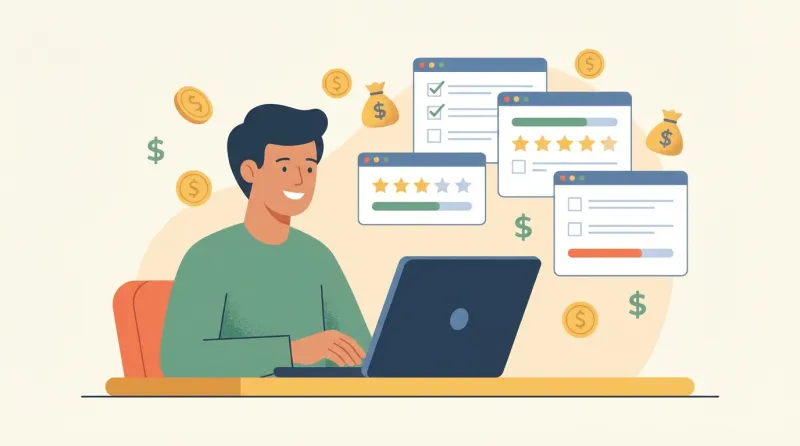
In 2026, every second of load time and every unnecessary click translates into millions of dollars in lost revenue for the world's biggest companies. That makes your opinion as an "everyday user" an incredibly valuable commodity. Companies like Google, Apple, and fast-growing e-commerce startups don't want to guess whether their app is intuitive — they want to know for sure, by watching you use it in real time. Making money through UX (User Experience) testing is one of the most interesting side hustles out there: it requires no coding skills, no specialist qualifications. Your only job is to record your screen — phone or computer — follow simple tasks (like "find a pair of shoes and add them to your cart") and narrate your thoughts out loud. For a 20-minute session like that, you can earn anywhere from $10 to $60, which makes this one of the highest-paying forms of part-time work relative to the time invested.
A lot of beginners quit early because they "never get invited to tests." That's a mistake rooted in not understanding how platform screening and technical requirements actually work. In 2026, being a UX tester is a game of speed and reliability. You need to know how to fill out a screener survey so you qualify for premium tests, and which mistakes to avoid during recording so you don't lose your payout. In this article, we'll break down the world of UX testing from the ground up. I'll show you the best platforms paying in dollars, walk you through realistic earning scenarios, and explain how to build a reputation as a "5-star tester" who gets invites every single day. Because in today's digital economy, your powers of observation are a capital asset waiting to be cashed in.
UX testing is a natural fit if you're already doing paid surveys or mystery shopping online. Think of it as the next level up in the hierarchy of getting paid for your opinions.
What Is UX Testing and Why Anyone Can Do It
UX (User Experience) is the field that studies how users feel when interacting with digital products. Companies pay you to be their guinea pig. Your job isn't to find bugs in the code — that's what QA engineers do — but to catch flaws in the logic and intuitiveness of a website or app. If you can't figure out where to click to reach the checkout page, that's a UX failure — and you get paid to flag it.
In 2026, the most valued testers are those who can "think aloud" (the Think Aloud Protocol). The research team doesn't just want to see your screen recording. They want to hear: "I'm looking for the contact button, but these bright banners keep distracting me... oh, now I notice the menu is hidden under a tiny icon I completely missed before." That kind of honest, natural commentary is worth a fortune, because it lets companies optimize their conversion rates and squeeze more revenue out of every visitor.
ℹ️ Three types of UX tests in 2026:
- Moderated tests: You speak live with a researcher over Zoom (Rates: $30–$100+).
- Unmoderated tests: You record yourself solo, following written instructions (Rates: $10–$20).
- Micro-tasks: Short 5-minute tasks like picking the better headline (Rates: $1–$5).
- Mobile tests: Done exclusively on your smartphone, often for apps that haven't launched yet.

Earnings: How Much Can You Realistically Make per Test?
Rates in the UX industry are remarkably stable and almost always quoted in USD. Here's what you can actually expect to earn in 2026, broken down by test type.
| Test Type | Duration | Rate (USD) | Monthly Potential |
|---|---|---|---|
| Quick usability test | 5–10 min | $4–$5 | $40–$80 (casual) |
| Standard test (video + audio) | 15–25 min | $10–$15 | $100–$300 (part-time) |
| Live moderated interview | 30–60 min | $30–$120 | $200–$600 (targeted) |
| Mobile prototype test | 20 min | $10–$20 | $100–$250 (mobile-focused) |
| Card sorting / tree testing | 10 min | $5 | $50–$100 (filler tasks) |
💰 Tester's wallet: Strategy for $200–$300/month
To consistently pull in $200–$300 per month from UX testing, you need to complete roughly 15–20 standard tests at $10–$15 each. That's realistically 6–8 hours of actual work per month. The key is signing up for 5–7 platforms simultaneously and keeping your dashboard open in a background tab so you can grab invitations the moment they appear. Dedicated testers who stack platforms — UserTesting, Userlytics, Respondent, and Trymata — report earning $500–$1,500/month part-time. With premium Respondent interviews at $50–$200/hour, motivated testers have hit $2,000+/month.

Best Platforms in 2026: Where to Find the Most Work
In 2026, the global UX testing market is dominated by a handful of major players. Most of them accept testers from anywhere in the world, provided you can communicate comfortably in English.
- UserTesting: The undisputed industry leader. Pays weekly to PayPal. They have the highest volume of tests but also the strictest screeners. Rates of $4–$10 per 5–20 minute test, and $30–$60 per live interview make this the first platform every new tester should join.
- Userlytics: Frequently features tests from large European and US brands. Very reliable, though the dashboard feels a bit dated. Rates vary widely — $5 for short tasks up to $90 for in-depth sessions. Worth it for those occasional premium studies.
- Trymata (formerly TryMyUI): A solid platform that pays a flat $10 per 20-minute test. They have high audio quality standards — if your microphone isn't decent, your recordings will get rejected during the verification step.
- UserBrain: German-rooted but operates globally in English. Pays around $5 per test, lower stakes but consistent volume. Good for building your rating when you're just starting out.
- PlaytestCloud: The holy grail for gamers. You test mobile games before they launch. Record your screen and voice while playing, and earn roughly $9–$15 for 15 minutes of gameplay. It's genuinely fun work.
- TestingTime: International platform with German roots, runs plenty of English-language sessions. Moderated tests pay the equivalent of ~$50/hr. Screener requirements are specific, but payouts are solid when you qualify.
- Respondent.io: The premium tier. These aren't $10 usability tests — these are research interviews at $50–$200/hour. B2B professionals and specialists get the best invites. Harder to qualify, but the payout when you do is exceptional.
- Userfeel: Multilingual platform, good option if you can test in multiple languages. $10 per test, global reach.
- Maze / Validately: More research-panel oriented. Good for supplementing income with shorter tasks and concept tests.

How to Pass Verification and Get More Test Invitations
Mistake number one: being too quiet during your practice test. In 2026, platform algorithms analyze your audio quality and how often you speak. If you go silent for a full minute, your recording gets flagged or rejected outright. You need to narrate everything: "I'm moving my mouse to the top-right corner... I expected a button here... there isn't one, I feel slightly confused about where to go next."
The second key is optimizing your profile for demographic targeting. Companies look for specific people: "men aged 25–35 who recently bought a car" or "small business owners who use Shopify." Fill out your profile completely — hobbies, devices you own, software you use at work, your household income bracket. The more data you give the platform, the more often its algorithm will surface tests that fit your profile. One hard rule: never lie in screener surveys. It's the fastest route to a permanent ban.
💡 The "First to Respond" trick
Test slots on UserTesting disappear in seconds. Install a tab auto-refresh extension in your browser, or use their mobile app with push notifications turned on. If you don't click an invitation within the first minute of it appearing, someone else will have already grabbed it. Speed is your biggest competitive advantage over the thousands of other testers on the platform.
Taxes and Legal: 1099s, Schedule C, and Staying Compliant
Working for US-based platforms means US-sourced income. Here's what you actually need to know to stay on the right side of the IRS.
🔴 Tax basics for US-based UX testers (CRITICAL)
Platforms will issue you a Form 1099-K or 1099-MISC once your earnings hit $600 in a calendar year — and they report it to the IRS. You'll report that income on Schedule C (Profit or Loss from Business) when you file your federal taxes. Self-employment tax kicks in at $400+ net profit: it's 15.3% covering Social Security and Medicare. On the plus side, you can deduct your home office, microphone, webcam, and a portion of your internet bill as business expenses. If your side income grows seriously, talk to a CPA about whether an LLC makes sense for liability and tax purposes. One more thing: protect your privacy during tests — use placeholder names and addresses in test forms unless the instructions specifically ask for real data.
UK testers follow a slightly different path: the £1,000 trading allowance means your first £1,000 of self-employment income per year is completely tax-free. Above that, you register for HMRC Self Assessment and report through your annual tax return. The Class 2 and Class 4 National Insurance contributions apply once you go over the small profits threshold. It sounds complicated, but the HMRC website has a solid self-employment guide that walks you through it step by step.
Tester Mindset: How to Keep Your Rating High and Stay Active
UX platforms live and die on data quality. If you start gaming the system — rushing through tasks, not reading instructions properly, phoning it in — your rating will drop below 4 stars. In 2026, falling below the platform threshold means getting locked out of premium tests permanently. This work rewards patience and conscientiousness, not speed.
- The "Zero Noise" rule: Record only in genuine silence. A barking dog, a noisy fan, or an air conditioner humming in the background will disqualify your recording. A cheap $15–$20 lavalier (clip-on) mic from Amazon is a one-time investment that pays for itself after one test.
- Read the instructions twice: If the task says "don't complete the purchase — stop at the payment screen" and you click "Buy Now" anyway, the client gets no useful data and you don't get paid. It happens more often than you'd think.
- Be genuinely critical: Don't praise everything to seem agreeable. Clients pay you for honest criticism. If something is confusing, broken, or ugly — say so, and explain why. That's your actual value as a UX tester, and it's what separates a 4.9-star tester from a 3.5-star one.
Action Plan: Your First Paid UX Test Within 7 Days
Don't put this off. Here's exactly what to do over the next week:
Days 1–2: Sign Up and Technical Setup
Create accounts on UserTesting and Userlytics. Configure your microphone, test your audio levels, and install any required screen recording extension. Complete the practice test (required before you get real invitations). Focus on speaking clearly and frequently — don't let silence creep in.
Days 3–4: Profile Optimization and PayPal Setup
Fill out all demographic surveys — every field. Make sure your PayPal account is verified (you won't receive payments without this). Complete any tax forms required by the platforms — typically a W-9 (US residents) or W-8BEN (non-US residents) to confirm your tax status.
Days 5–7: Active Screener Hunting
Keep a platform tab open in the background while you do other work. Respond to every screener questionnaire you see. Don't get discouraged if you're rejected 9 times out of 10 — that's completely normal. Your only goal this week is to complete your first paid test and pocket that first $10–$15. Once you've done one, the process becomes second nature.

FAQ — Common Questions About UX Testing Jobs
How much money can you actually make doing UX testing?
Part-time, with a few hours per week across 3–4 platforms, $50–$300/month is realistic. Dedicated testers who treat it seriously — stacking UserTesting, Userlytics, Trymata, and Respondent — report $500–$1,500/month. The ceiling is around $2,000+/month if you consistently land premium Respondent or TestingTime interviews. It's not a full-time replacement income, but as a side hustle it has an unusually high hourly rate.
How many test invitations can you get per day?
It depends heavily on your demographic profile. The average tester receives 3–10 screener invitations per day, qualifying for 1–2 actual tests. Some demographics (small business owners, specific age groups, niche software users) are more in demand and get more opportunities. The number goes up as your rating improves and your profile becomes more detailed.
Do you have to show your face on camera?
Usually not. About 90% of tests are screen recording plus voice only — no webcam required. Moderated face-to-face sessions (live Zoom interviews) are less common but pay 3–4x more, sometimes $60–$120 for an hour. You can opt out of those if you prefer to stay off camera.
Is UX testing worth it as a side hustle?
Yes — for the right kind of person. If you're observant, articulate, and don't mind narrating your thoughts out loud, the hourly rate is hard to beat in the gig economy. The barrier to entry is low (a decent mic and a stable internet connection), payments are reliable (most platforms pay within 7 days via PayPal), and you're genuinely helping companies build better products. The main downside is inconsistency — you can't always predict when tests will appear or whether you'll qualify.
Summary: Your Observations as Income
📋 UX Testing Mastery — 10 Rules to Live By
- Think out loud: Silence is your biggest enemy during a test. Narrate everything.
- Be honest: Genuine criticism is worth more than empty praise — clients pay for it.
- Invest in audio: A clean recording is your ticket to acceptance. A $20 mic pays for itself fast.
- React fast: Test invitations are live for minutes, sometimes seconds.
- Diversify platforms: Register on UserTesting, Userlytics, Trymata, UserBrain, and Respondent.
- Complete your profile: The more data you provide, the more tests the algorithm sends your way.
- Sort out your taxes: Platforms report to the IRS at $600+. Keep records of every payout.
- Set up PayPal properly: A verified PayPal account is non-negotiable before you start.
- Prioritize mobile tests: Mobile apps now make up around 70% of UX testing volume.
- Start today: Signing up for UserTesting takes 15 minutes and costs nothing. There's no reason to wait.
Getting paid to test websites and apps in 2026 is one of the smartest side hustles available to people without a technical background. You're combining the roles of researcher, reviewer, and end user — actively helping companies build a better internet. Beyond the paycheck, it sharpens your analytical thinking and gives you a rare inside view of how the world's most successful digital products are actually built and refined. Whether you want to cover a phone bill or build up a serious dollar-denominated savings cushion, UX testing gives you all the tools to do it. Stop just scrolling through apps. Start rating them — and getting paid for your insights. The user research market is waiting for your voice. Go get it.


Comments (0)
No comments yet. Be the first!
Add a comment