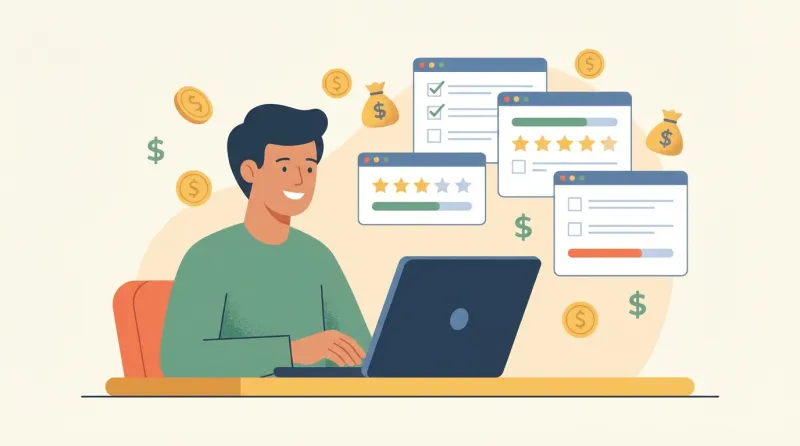
Paid online surveys are one of those side-hustle ideas that pretty much everyone has heard of at some point. Sign up, answer some questions, get paid. Simple enough, right? And honestly — in theory, yes. But can you actually earn anything meaningful from it, or is it just nickels and dimes dressed up as an opportunity?
The truth, as usual, sits somewhere in the middle. Online surveys are real money — just not much of it. For some people, it's a decent way to pocket an extra $30–$80 a month while watching TV. For others, it's a disappointment because they expected something more. Before you dive in, read this guide — it'll save you a lot of frustration.
How Much Can You Realistically Earn From Online Surveys
I'm not going to sugarcoat it. Surveys aren't a living. They're micro-earnings — we're talking a few dollars per hour of actual effort. Here's what it looks like in practice:
| Effort level | Time per day | Monthly earnings | Hourly rate |
|---|---|---|---|
| Casual (1–2 platforms) | 15–30 min | $15–$40 | ~$3–$5/hr |
| Regular (3–5 platforms) | 30–60 min | $40–$100 | ~$4–$8/hr |
| Intensive (8+ platforms) | 2–3 hours | $100–$180 | ~$3–$6/hr |
⚠️ Honest warning
Your effective hourly rate will typically land between $2–$8/hour — well below federal minimum wage. And that's before you factor in screenout time (getting disqualified 3 minutes into a survey), waiting for new studies to appear, and juggling multiple accounts. On a realistic bad day, you'll earn under $3 for an hour of effort. If you have other income options, consider those first.
What does a single survey pay? It depends entirely on length:
- Short (5–10 min): $0.25–$1.00
- Standard (15–20 min): $1.00–$3.00
- Long / specialist (30+ min): $3.00–$10.00
The exception is Prolific, which explicitly aims for £6/hour minimum ($7–$9 USD equivalent) — it's the most ethical platform in the space and the one r/beermoney consistently recommends above everything else. But access to high-paying studies is competitive and not guaranteed daily.
Best Survey Platforms for US and UK Users — 2026 Rankings
There are dozens of survey platforms out there. Don't bother registering on all of them — many are dead, pay in gift cards you'll never use, or have withdrawal thresholds so high you'll be collecting dust for a year. Here are the ones that actually work:

Top platforms — cash payouts via PayPal
| Platform | Min. withdrawal | Payout method | Rating |
|---|---|---|---|
| Prolific | $5 (£5) | PayPal / Circle | ⭐⭐⭐⭐⭐ Best overall |
| Pinecone Research | $3 per survey | PayPal, check, gift cards | ⭐⭐⭐⭐⭐ Fixed $3/survey |
| Branded Surveys | $5 | PayPal, gift cards | ⭐⭐⭐⭐ Consistent volume |
| Survey Junkie | $5 | PayPal, e-gift cards | ⭐⭐⭐⭐ Great for beginners |
| Swagbucks | $3 | PayPal, 1,500+ gift cards | ⭐⭐⭐⭐ Surveys + tasks |
| MyPoints | $10 | PayPal, gift cards | ⭐⭐⭐ Good bonus offers |
Specialist and higher-paying platforms
| Platform | Min. withdrawal | Method | Notes |
|---|---|---|---|
| UserTesting | $10 | PayPal | UX tests, $10/20-min session — not just surveys |
| YouGov | ~5,000 pts (~$50) | PayPal, gift cards | Longer, more interesting surveys — slow to cash out |
| Respondent.io | Per project | PayPal | $50–$200/hr for focus groups — highly selective |
| Freecash | ~$2 equiv. | PayPal, crypto, gift cards | 4.7 Trustpilot — surveys + offers + gaming tasks |
💡 My starting recommendation: Prolific + Branded Surveys + Swagbucks
Prolific has the highest ethical standards and best pay rates — start there. Branded Surveys gives you consistent volume to fill the gaps. Swagbucks has an extremely low $3 withdrawal threshold, so you get that first dopamine hit of an actual payout fast. These three together cover most of your daily survey availability. Add Pinecone Research if you get an invite — their fixed $3 per survey (regardless of length) is unusually fair.
How to Start — Step by Step
Register on 5–8 platforms at once
One panel gives you nowhere near enough surveys. My recommended starting stack: Prolific, Branded Surveys, Swagbucks, Survey Junkie, and Freecash. Each pulls from different research clients — together they create a reasonable daily flow. Add Pinecone Research and YouGov once you're set up with the basics.
Complete your profile 100% on every platform
This is non-negotiable. The matching algorithm sends you surveys based on your profile data — age, gender, education, occupation, purchase habits, household composition. The more complete your profile, the more targeted (and qualifying) surveys you'll receive. Spend 15 minutes doing this. It pays back many times over.
Respond quickly — survey slots fill up fast
Research companies need a specific number of respondents from each demographic group. Once that quota fills, the survey closes — even if you were invited. Turn on push notifications in apps and aim to respond within an hour of receiving an invitation. On Prolific especially, popular studies vanish in minutes.
Cash out regularly — don't let points accumulate
Withdraw as soon as you hit the minimum threshold. Platforms can close accounts and points can disappear. YouGov takes ages to reach the payout threshold anyway — don't add unnecessary risk by letting other platforms pile up too. Real money in your PayPal beats 500 points in a system that can change its T&Cs overnight.
Answer honestly and consistently
Platforms build in attention check questions and response-consistency traps. Clicking randomly to speed through surveys will get you banned — permanently, with no appeal. Prolific in particular has a strong reputation system. Protect your account rating from day one; it determines which studies you get invited to.
Pitfalls You Need to Know About

Screenouts — the biggest frustration
Every survey starts with a handful of screening questions. After 3–5 minutes, you might hit a wall: "Sorry, you don't qualify for this study." No reward. This is completely normal in the industry — most platforms don't pay for screenouts (Prolific is a notable exception, offering a small "rejection" payment). Factor this time in and accept it as part of the process, not a bug.
ℹ️ How screening questions work
Research clients need very specific profiles: women 35–45, employed in healthcare, who bought a new vehicle in the last 18 months, for instance. If you don't match — you're out. That's why a detailed profile (step 2) is critical. The algorithm won't even send you surveys you'd fail to screen for. A complete profile means less wasted time and fewer frustrating disqualifications.
Expiring points and reward locks
YouGov's payout threshold is genuinely high — you're accumulating points for months before you can redeem anything. Some platforms let points expire if there's no activity. And a few — like the UK's Opinion Outpost — pay primarily in gift cards rather than cash. If you need actual money in your bank account, check the payout method before committing serious time to any platform.
Account bans
The rule is: 1 account / 1 IP / 1 device / 1 person per household. Creating a second account, sharing access with a family member, or answering surveys from two different devices on the same WiFi — all grounds for a permanent ban. There's no appeals process. Points are gone. Start fresh accounts only, one per platform.
⚠️ High withdrawal thresholds — a patience trap
YouGov requires roughly $50 worth of points before you can cash out. At $5–$10 a month in earnings, you're looking at 5–10 months before seeing a penny. Start with low-threshold platforms — Swagbucks ($3), Prolific ($5), Survey Junkie ($5) — because that first payout is a genuine motivation booster. Seeing money actually hit your account is what keeps most people going past week two.
Surveys vs. Other Micro-Earning Methods — What Should You Pick?
| Method | Monthly earnings | Time | Hourly rate | Barrier to entry |
|---|---|---|---|---|
| Online surveys | $20–$100 | 30–60 min/day | $2–$8/hr | None |
| Micro-tasks (Amazon MTurk, Appen) | $50–$200 | 1–2 hrs/day | $5–$15/hr | Basic English, some skill |
| Cashback apps (Rakuten, Honey) | $20–$80 | 0 extra time | Passive | You shop online anyway |
| UX testing (UserTesting, Respondent) | $50–$300 | 1–3 hrs/week | $10–$100/hr | Registration + selection |
| Transcription (Rev, Scribie) | $100–$400 | Part-time hours | $5–$20/hr | Accuracy + typing speed |
Verdict? Surveys have the absolute lowest barrier to entry — no skills, no experience, no investment. That makes them perfect as a first experiment in online income. But if you have 30–60 minutes a day to spare, UX testing will return 5–10x more per hour for a similar time commitment. Worth exploring micro-tasks and task-based platforms too — they pay better and build transferable skills.
💰 Strategy: use surveys as a launchpad, not a destination
Treat surveys as your entry point. The earnings are modest, but you're building something genuinely useful: the habit of earning online. Consistency, tracking payouts, managing multiple accounts. These are real skills that transfer to better-paying work like freelancing or content creation. Think of the first $50 from surveys as proof of concept — then level up.
Taxes — Do You Need to Report Survey Income?
Survey earnings are taxable income in both the US and UK. But at typical earning levels, the practical impact is close to zero. Here's the actual situation:
ℹ️ US: 1099 reporting and self-employment thresholds
In the US, platforms are required to issue a 1099-MISC only if they pay you $600 or more in a calendar year. Below that, they typically don't report to the IRS — but you're still legally required to report the income yourself on Schedule C or Schedule 1. If your net self-employment income exceeds $400, you may owe self-employment tax. At $50–$100/month from surveys, you'll likely stay under the $600 reporting threshold, but it's still your income to declare. Consult a tax professional if unsure.
In the UK, HMRC's trading allowance gives you £1,000 per tax year of miscellaneous income completely tax-free — no need to file a self-assessment return below that amount. Most casual survey earners stay comfortably under this threshold. Above £1,000/year, you'd need to report it via self-assessment, but there's no National Insurance on survey income since it's not treated as employment.
Bottom line: at $30–$100/month, your tax liability from surveys is almost certainly zero. But keep a simple spreadsheet of what you earn on each platform — takes two minutes per payout and removes any guesswork at year end.
AI and Online Surveys — Does This Industry Have a Future?
This is worth taking seriously. A 2025 study from Dartmouth University published in PNAS confirmed what many suspected: large language models can complete survey responses so convincingly that distinguishing AI from a human respondent is essentially impossible at scale.
What does this mean for real users filling surveys honestly? Several things happening simultaneously:
- Platforms are tightening verification — more CAPTCHA, honeypot questions, response-timing analysis, device fingerprinting
- Legitimate users are getting false-flagged more often as anti-bot systems misidentify human behavior patterns
- Companies like Scale AI and Appen, which built empires on human data labeling, are already seeing rate compression as AI handles more of what humans used to do
- Longer-term, survey rates could drop if research firms realize they're buying AI-generated opinions instead of real human perspectives — and restructure their sourcing accordingly
💡 What this means practically for you right now
In 2026, the situation is still stable. The major platforms (Prolific, Branded Surveys, Survey Junkie) are operating normally and payout rates haven't collapsed. But this is not a sector to build a long-term income strategy around. Treat surveys as a present-tense activity — something to do now while also developing skills that won't be disrupted by AI in the next two to three years. Data labeling, RLHF annotation, and qualitative UX research are the adjacent areas still requiring genuine human judgment.
FAQ — Most Common Questions About Paid Surveys
How many surveys will I actually get per month?
On a single platform: expect 5–30 surveys per month depending on your demographic profile and how much activity the platform sees. That's why you need 5–8 panels running simultaneously — together they generate 30–100 invitations monthly, and you'll qualify through screening on maybe 30–50% of those. The more specific and complete your profile, the better your match rate and the more invitations come your way.
Are paid survey sites actually legit, or is it a scam?
The platforms listed in this article are legitimate — they pay. The issue isn't that they're scams; it's that they pay very little. What IS a scam: any survey site that promises hundreds of dollars for "easy" work, charges a registration fee, or asks for your credit card information. Legitimate survey platforms never charge you to join. If they're asking for money upfront, leave immediately.
Can I register on multiple platforms at the same time?
Yes — and you should. Each platform taps into a completely different pool of research clients and studies. Running 6–8 platforms simultaneously is standard practice among active earners. The only hard rule: one account per platform. Creating a second account on the same site is grounds for a permanent ban on both accounts, with no chance of recovering your points.
Why do I keep getting screened out of surveys?
This is completely normal — even experienced users get screened out of 60–70% of surveys they attempt. The reasons: your profile doesn't match the exact demographic the client needs, the quota for your segment is already full, or your answers are inconsistent with your profile information. The fix: fill out your profile completely and accurately, answer screening questions consistently with what you've already stated, and accept that screenouts are an unavoidable part of this work — not a sign something's wrong.
How long until I get my first payout?
On Swagbucks (threshold: $3) or Prolific (threshold: $5) — realistically 2–4 weeks if you're active daily. On Branded Surveys ($5 threshold) — similar timeline. On YouGov (threshold: ~$50) — several months minimum. This is exactly why starting with low-threshold platforms matters so much: that first payout arriving in your PayPal account is a psychological milestone that makes everything feel real and worth continuing.
Do I need to pay taxes on survey earnings?
Technically yes — it's taxable income in both the US and UK. In the US, platforms only issue a 1099-MISC if you earn $600+ from them in a year. At $50–$100/month, you'll typically stay under this threshold, but the income is still yours to declare. In the UK, you're covered by the £1,000 trading allowance — most casual survey earners never exceed it. In practice, at typical survey earnings, your actual tax liability is usually zero. Keep basic records and you're fine.
Summary
📋 Paid Online Surveys — The Bottom Line
- Monthly earnings: $20–$100 with regular activity across multiple platforms
- Per-survey rate: $0.25–$10 depending on length and specialization
- Hourly rate: $2–$8/hour — below federal minimum wage
- Best US/UK platform: Prolific (ethical pay standards, $5 min withdrawal) + Branded Surveys (volume)
- Best for beginners: Swagbucks ($3 withdrawal threshold — fastest first payout)
- Minimum platforms to run: 5–8 simultaneously — one panel alone doesn't generate enough surveys
- Screenouts: Normal — expect 50–70% of invites to end in disqualification, this is by design
- Main pitfall: High withdrawal thresholds (YouGov: ~$50) and points that can expire or disappear
- Tax situation: Usually zero tax liability at typical earnings — but keep basic records
- Best strategy: Use surveys as an income on-ramp, then develop skills that pay significantly more


Comments (0)
No comments yet. Be the first!
Add a comment