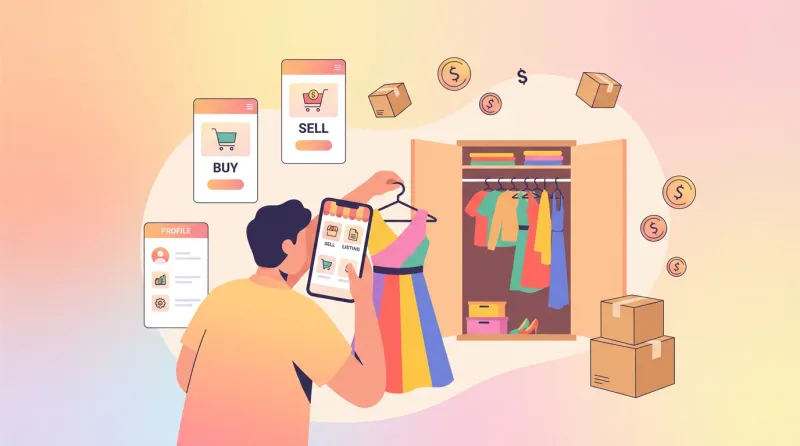
Honestly? Most of us have a few hundred dollars — probably more — sitting in our closets doing absolutely nothing. That impulse-bought jacket still with the tags on. The kitchen gadget you used twice. The pile of clothes you keep meaning to "get back into." For years, selling that stuff felt like too much hassle: taking photos, dealing with messages, queuing at the post office. But in 2026, the whole process has changed. Apps like Depop, Vinted, Poshmark, and Facebook Marketplace have made listing an item almost as easy as ordering takeout — and for a growing number of people, reselling secondhand isn't just a declutter strategy. It's a genuine income stream.
If you've been wondering whether it's still worth jumping in — especially with new tax reporting rules coming into force — the short answer is yes, absolutely. The secondhand market in the US is on track to hit $70 billion by 2027, and in the UK, one in three adults bought a secondhand item online last year. Rising prices for new goods have made thrifting mainstream, not just budget-conscious. In this guide, I'll walk you through everything: how to take photos that actually sell, which platform suits what you're selling, what the tax rules mean for you (they're less scary than they sound), and how much you can realistically expect to earn.
Which Platform? Depop, Vinted, eBay, Poshmark — Where to Start
The platform you choose matters more than most people think. Each one has its own community, fee structure, and sweet spot of what sells well. Getting this wrong means listing something in the wrong place and wondering why nothing moves.
🔵 Vinted UK: Zero seller fees, huge fashion community
Vinted has exploded in the UK and is arguably the best starting point for clothing, shoes, bags and accessories. Sellers pay nothing — the buyer pays a small Buyer Protection fee. You get integrated shipping labels and a clean, visual browsing experience. Cross-border selling to France, Germany, Belgium and beyond is built in, which dramatically expands your potential buyers.
🟠 Depop: Where vintage and Y2K fashion lives
Depop has a strong Gen Z and millennial audience with a genuine appetite for vintage, Y2K, streetwear and anything with a distinct aesthetic. It charges a 10% seller fee. Think of it as part marketplace, part social platform — your profile, how you style your photos, and your overall "vibe" all matter. If you're selling anything with personality, Depop is worth your time.
🔵 eBay: The reliable all-rounder
eBay is still the go-to for tech, electronics, collectibles, books, vinyl, LEGO, and anything where buyers are searching by model number or exact title. The final value fee sits around 10–15.7% depending on category. Auctions work well for rare items where you're not sure of the price — the market will tell you.
🟡 Facebook Marketplace: Free, local, and underrated
For bulky items — furniture, exercise equipment, baby gear, appliances — Facebook Marketplace is hard to beat. No fees for local sales, no shipping to organise, cash in hand. The built-in audience of millions means things move fast if you price them right. Just be sensible about meeting strangers: public places, or doorstep handoffs only.
| Platform | Best for | Seller fee | Reach | Trust level |
|---|---|---|---|---|
| Vinted UK | Clothes, shoes, accessories | Free (buyer pays) | UK + Europe | High (Buyer Protection) |
| Depop | Vintage, Y2K, streetwear | 10% + payment fee | UK, US, global | High (Depop Payments) |
| eBay UK | Tech, collectibles, books | ~15.7% final value | Global | Very high |
| Poshmark (US) | Designer fashion, brands | 20% on $15+, $2.95 flat under | US, Canada, Australia | High |
| Mercari (US) | Mixed: clothes, tech, home | 10% + 2.9% + $0.50 | US | Medium-high |
| Facebook Marketplace | Furniture, large items | Free (local) / 5% shipped | Local + national | Medium (no buyer protection) |

Product Photography: How to Sell Items in Minutes
Online buyers buy with their eyes first. You might have a barely-worn designer jacket at half the retail price, but if the photo is dark, blurry, and draped over a chaotic bedroom floor — it's going to sit there for weeks. Or sell for far less than it's worth.
Smartphone photography for reselling is a genuine skill, but it takes about ten minutes to learn the basics. Daylight is everything. Natural light — ideally on a slightly overcast day so you don't get harsh shadows — shows colours accurately and picks up fabric textures in a way artificial lighting never does. Flash is your enemy. It flattens everything and creates that unmistakable "charity shop photo" look that makes buyers scroll past.
Background matters too. A plain white wall, a clean wooden floor, or even a large piece of white card from a craft store. The background shouldn't compete with the item. When buyers see clutter behind the product, something subtle happens in their brain: "Is this item actually clean? Does it smell?" You don't want them thinking that. Keep it simple.
💡 The lifestyle shot trick
Clothes sell around 40% faster when shown on a person or styled as a flat lay with a few complementary accessories — sunglasses, a bag, some jewellery. You're not just showing an item, you're showing a look. On Depop especially, this is the standard. You don't need a model; a hanger against a nice wall works fine, but "on person" beats everything.
Shoot from multiple angles: front, back, label with size and fabric content, any details worth highlighting (stitching, hardware, print), and — critically — any flaws. That small mark on the sleeve? Photograph it close-up. Buyers who know about a flaw before they buy won't complain afterwards. Buyers who discover it on delivery will open a case against you. Being upfront protects your seller rating far more than hiding imperfections.

Listings and SEO: Getting Found by the Right Buyers
The search algorithms on Depop, Vinted, eBay and Poshmark all work on keywords. "Nice blue top" won't surface in anyone's search. "Zara linen oversized shirt blue size M summer 2024" might get you twenty views in an hour.
Think about how a buyer would search for your item. They're not searching for "lovely vintage piece" — they're searching for "Ralph Lauren polo shirt navy medium" or "Y2K baby tee graphic print 90s small." Use the brand, the garment type, the colour, the size, the style category (vintage, Y2K, cottagecore, workwear), and — if it's fashion — the approximate decade or era.
In the description, be completely honest. Include measurements. Don't say "size M" — tell them the chest measurement, the length, the sleeve length. Every brand runs differently, and "medium" from one label is a small in another. Giving measurements eliminates about half of all buyer questions, saves you hours of back-and-forth, and dramatically reduces returns.
🔵 Price higher than your target — leave room to negotiate
Set your price about 10–20% higher than the minimum you'd accept. People love making an offer. If your item is worth $40, list at $48–50. You'll get offers at $40 all day. On Poshmark especially, "liking" an item triggers a price drop notification — use this to your advantage by setting up targeted discounts for engaged buyers.
US and UK Tax Rules: What Resellers Actually Need to Know
This is the section everyone has questions about — usually because they've seen something alarming on social media. The reality is considerably less dramatic than the headlines suggest.
In the US, the 1099-K reporting threshold has been in flux. For 2024, platforms are required to send you a 1099-K if your payments exceed $5,000 (down from the old $20,000 threshold, with the $600 figure being the long-term goal that keeps getting delayed). Getting a 1099-K doesn't automatically mean you owe tax — it just means the IRS knows you received that money.
⚠️ US vs UK tax — the key rules at a glance
United States: If you're selling items you already own at a loss (which is almost always the case for personal clothes), there's no taxable gain. You're selling a depreciated personal asset. Where it gets complicated is if you're buying to resell for profit — that's taxable income. If it becomes a regular activity with profit motive, Schedule C applies (self-employment tax kicks in above $400 net profit).
United Kingdom: You have a £1,000 trading allowance per tax year. Sell under £1,000 from all trading? No need to report anything to HMRC. Over £1,000 and it becomes income you'll need to declare via Self Assessment. Capital Gains Tax doesn't apply to personal possessions sold for under £6,000 each — so selling your personal wardrobe is almost always CGT-free.
The practical upshot: if you're clearing out your own wardrobe and selling things for less than you paid for them (which is basically always true for clothes), you're unlikely to owe any tax in either country. The situation changes when you start buying specifically to resell — that's when you're in trading territory and should track your costs and income properly.
🔵 Keep records from day one — it takes minutes and saves stress
Even if you don't think you'll hit any thresholds, keep a simple spreadsheet: what you paid, what you sold it for, platform fees, and any shipping costs. This takes 30 seconds per sale. If HMRC or the IRS ever asks questions, you have clean records. If you don't, you might end up paying tax on gross revenue rather than profit — which is much worse.
Avoiding Scams: How to Protect Yourself
The growth of reselling platforms has attracted scammers in proportion. The most common one goes like this: you list an item, and almost immediately a "buyer" messages you on WhatsApp, Instagram DMs or by email — not through the platform's own messaging. They claim to have already paid, send you a link that looks convincingly like a shipping company or payment portal, and ask you to "confirm" your bank details to "release the funds." The link is fake. There are no funds.
The rule is simple: keep everything inside the platform. Real buyers pay through the platform's checkout. Real shipping labels are generated inside the app. If someone is trying to take the transaction off-platform, end the conversation.
⚠️ Red flags to watch for
- Any message asking you to continue the conversation on WhatsApp, Telegram or email
- "I've already paid — just click this link to receive the money"
- Overpayment cheque scams: "I'll pay $300 for your $50 item, please refund the difference"
- Requests for your card number, CVV, or bank login to "verify" a payment
- Buyers who want you to ship immediately before payment clears
One practical habit: photograph your item in its packaging before you seal it. This is your proof of condition at dispatch. If a buyer later claims the item was damaged or not as described, you have evidence of exactly what you sent. On most platforms, this documentation significantly tips dispute resolution in your favour.
How Much Can You Realistically Earn?
Let's split this into three realistic tiers. Where do you see yourself?
💰 Tier 1: The Closet Clearer ($50–$400/month)
You do a wardrobe audit once a month, pull out 10–20 items you haven't worn in a year, and list them over a weekend. This is pure profit — you're converting clutter into cash with zero upfront investment. The money goes towards something specific: a short break, a new pair of trainers, paying down a bill. For most people, this tier alone is worth doing. It takes maybe two to three hours a month once you're set up.
💰 Tier 2: The Thrift Flipper ($500–$2,000/month)
You've figured out that charity shops, estate sales, car boot sales and end-of-season outlet sales are full of things people will pay multiples for online. You know which brands hold their value — think Levi's, Ralph Lauren, Nike vintage, Barbour, anything designer. You're spending maybe four to eight hours a week sourcing and listing. At this tier you're probably tracking income for tax purposes and thinking about whether to formalise things. This is a proper side hustle.
💰 Tier 3: The Full-Time Reseller ($3,000–$10,000+/month)
This is a business. You might be sourcing from wholesale suppliers in Italy or Eastern Europe, buying job lots, or specialising in a niche (luxury handbags, vintage sportswear, vinyl records, collectable toys). You have a dedicated photography setup, a process for packing and shipping, and you're across multiple platforms simultaneously. Tax is sorted — you're either self-employed (Schedule C in the US, sole trader or limited company in the UK) or working with an accountant. The income is real and consistent.

Shipping and Logistics: Making It Painless
Shipping is where a lot of new resellers get tripped up — not because it's complicated, but because they haven't set up a system. Once you have one, it takes maybe five minutes per order.
Most platforms generate prepaid labels directly in the app. On Vinted UK, the buyer pays for shipping and a label is generated automatically when they purchase. On Depop and Poshmark, you can choose to offer free shipping (build it into your price) or charge the buyer. eBay gives you the most flexibility but also requires the most decisions upfront.
For US sellers, USPS First Class is your friend for anything under 15.99 oz — it's the cheapest option and perfectly reliable for clothes. For heavier items, compare USPS Priority, UPS and FedEx rates through a service like Pirateship, which gives you commercial rates without any subscription. UK sellers: Royal Mail Tracked 48 is the standard workhorse. For anything going to Europe from the UK, check Vinted's built-in cross-border options — they've negotiated good rates with DPD and Hermes.
💡 Stock up on packaging — it pays off
Save jiffy bags and cardboard boxes from your own deliveries. USPS will give you free Priority Mail boxes if you ship USPS Priority — pick them up at any post office or order online. Bubble wrap from charity shops or Facebook Marketplace "free stuff" listings costs nothing. Buyers on Depop and Vinted actively appreciate eco-friendly packaging — and sometimes mention it in reviews, which builds your reputation.
What Sells Best in 2026: Categories Worth Knowing
Not everything moves at the same speed or at the same margins. After a few months of selling, you'll develop instincts for this, but here are the categories that consistently perform well right now.
Vintage and branded clothing is the engine of Depop and a strong performer on Vinted. Levi's jeans, Ralph Lauren polos, Barbour jackets, Stone Island, Nike and Adidas vintage pieces — anything branded and in good condition sells fast. Y2K fashion (roughly 2000–2010 aesthetics) is especially strong right now. Baby tees, low-rise jeans, branded tracksuits.
Tech does well on eBay. Apple products (iPhones, iPads, MacBooks, AirPods) hold value exceptionally well. Gaming consoles — especially the previous generation once the new one is out — sell fast. Retro consoles and games are a niche with passionate buyers who pay well for good condition items.
Kids' clothing in bundles is a reliably fast category. Parents know children grow out of things quickly and prefer to buy secondhand. Bundle by size and age range — "10 pieces age 3-4, mixed brands" — and price sensibly. These move quickly on Vinted.
Collectibles and niche items — vintage vinyl records, LEGO sets (especially retired ones), Pokémon cards, designer accessories, vintage cameras — can have extraordinary margins if you know the market. The risk is that you need product knowledge; without it, you might overpay for things that won't sell.
Action Plan: Start This Weekend
The best moment to start was last month. The second best moment is now. Your items are depreciating — clothes go out of fashion, tech becomes outdated, kids' toys lose their moment. Here's a concrete starting plan.
The big sort
Pull everything out of your wardrobe and make three piles: Keep, Donate/Recycle, and Sell. Be ruthless. If you haven't worn it in a year and aren't actively planning to, it goes in one of the last two piles. Prioritise the sell pile for anything branded, in good condition, or something you'd actually search for online yourself.
Photo session
Pick your five best items. Wait for good natural light (daytime, near a window). Shoot each item from at least five angles: front, back, label, any notable details, and any flaws. Lay clothes flat or hang them — whichever looks cleaner. You don't need any equipment beyond your phone.
List with keywords
Download Vinted (UK) or Depop, create a free account, and list your five items. Use keywords in every title: brand, garment type, colour, size, style. Price 10–15% higher than your minimum to leave room for offers. Check what similar items recently sold for — not just what they're listed at.
Reply fast, ship faster
When someone asks a question, answer it quickly — buyers compare listings and the seller who responds first often gets the sale. When something sells, ship the same day or next day. Speed builds your seller reputation faster than anything else, and a strong reputation brings in more buyers organically.
FAQ — Common Reselling Questions Answered
Do I need to pay tax on personal items I sell at a loss?
In most cases, no. In the US, selling personal property at a loss isn't a taxable event — you can't claim the loss either, but you don't owe tax. In the UK, the £1,000 trading allowance covers most casual sellers, and Capital Gains Tax doesn't apply to personal possessions sold for under £6,000 each. If you consistently sell for profit by buying items specifically to resell, that's trading income and should be declared. When in doubt, a free hour with an accountant is money well spent.
A buyer claims the item arrived damaged — what do I do?
This is where that pre-shipment photo becomes invaluable. Take a photo of the packaged item before you seal it and another showing the item inside the packaging. If a buyer raises a dispute, you can show the platform exactly what condition the item was in when it left you. On Vinted, Depop and eBay, this evidence typically results in a decision in the seller's favour if the damage clearly wasn't pre-existing.
How do I handle lowball offers without it becoming a fight?
Don't react emotionally. A low offer isn't an insult — it's someone testing whether you're flexible. Reply politely: "Thanks for the offer! The lowest I can go is $X." Often they come back at or near your price. If they don't, no harm done. On Poshmark and eBay, you can counter-offer directly through the platform's built-in offer system, which keeps things clean and non-confrontational.
Is it worth selling internationally on Vinted?
Yes, and it's easier than it sounds. Vinted handles the cross-border shipping labels and currency conversion automatically. You list in your local currency, and buyers in France, Germany, Belgium, the Netherlands and elsewhere can purchase without either of you needing to deal with international logistics. The label is generated in the app. For anything fashion-related, international sales can significantly increase how quickly your items sell — especially for smaller sizes or more niche styles that have a limited local buyer pool.
What are the best things to look for at charity shops and thrift stores to resell?
Focus on brands: Levi's, Ralph Lauren, Nike, Adidas, Patagonia, North Face, Barbour, Burberry, any luxury label at any price. Check the fabric label — natural fibres (wool, cashmere, linen, silk, 100% cotton) hold up better and sell better. Look for vintage prints, graphic tees from bands or events, and anything with clear Y2K or 90s aesthetic. For non-clothing: check the electronics section for Apple products, retro games consoles, and brand-name cameras. LEGO, Playmobil and vintage toys in decent condition also sell consistently well online.
Summary: Your Closet, Your Side Income
📋 Secondhand Selling in 2026 — Key Takeaways
- Platform matters: Vinted for clothes (UK/Europe), Depop for vintage/Y2K, eBay for tech and collectibles, Facebook Marketplace for big items.
- Light before everything else: Natural daylight from a window transforms your photos and your sales speed.
- Keywords sell items: Brand + type + colour + size + style in every title. "Zara linen shirt blue oversized M" beats "nice top" every time.
- Be honest about condition: Photograph flaws, write them in the description. One return or bad review costs more than it's worth.
- Tax isn't as scary as it sounds: Selling your own stuff at a loss? Likely zero tax obligation. Buying to resell for profit? Track your costs and income from day one.
- Stay inside the platform: All payments, all shipping, all communication. Anyone taking you off-platform is almost certainly a scammer.
- Price with room to negotiate: List 10–15% above your minimum. Buyers love to feel they got a deal.
- Ship fast: Same-day or next-day dispatch builds your seller rating faster than any other single action.
- Thrift stores are a goldmine: With the right product knowledge, sourcing from charity shops and car boots can turn $10 into $80 in a weekend.
- Consistency compounds: List 1–3 new items a day. Algorithms reward active sellers with better search placement.
Selling secondhand online isn't just a way to clear out space — it's a crash course in marketing, negotiation, customer service and basic logistics. Some people start with a wardrobe clearout and find, six months later, that they've got a real business going: a niche they understand, a following on Depop, a system that runs itself. Others just enjoy the steady trickle of extra cash. Either way, the barrier to entry is a free app and the stuff already sitting in your home. That's a pretty good starting point.
Comments (0)
No comments yet. Be the first!
Add a comment