In 2026, the dream of owning your own clothing brand no longer requires thousands of dollars upfront, warehouse space, or the risk of sitting on inventory that won't sell. Thanks to the Print on Demand (POD) model, you can launch a global store selling T-shirts, mugs, and posters in a single afternoon — from your couch. The mechanics are brilliantly simple: you create the design, and a third-party print facility handles production, packing, and shipping directly to the customer only once an order comes in. Financial risk? Practically zero. Potential? The whole world — from New York and London to Sydney and beyond. In this guide, I'll show you how to "hack" the POD market, which is experiencing a genuine renaissance in the age of AI.
A lot of people dismiss Print on Demand as "cheap T-shirts with slogans." That's a mistake costing them thousands of dollars in lost revenue. In 2026, the POD model covers everything: from premium sneakers and home decor to specialty jewelry and wall art. The key to success isn't being "the world's greatest designer" — it's finding a micro-niche: a specific group of people with unique passions who are actively searching for products that reflect their identity. We'll walk through the entire process together: designing with AI tools, choosing platforms that don't eat all your margin, and ultimately building a stream of passive income that flows into your account even while you're on vacation. Print on Demand is e-commerce done smart.
The POD model pairs beautifully with selling on Etsy and growing your audience on Instagram. It's one of the best ways to monetize your creativity without leaving home.
What Is Print on Demand and Why It's Such an Ideal Model?
Imagine you have an idea for a funny design aimed at ant-farming enthusiasts. In the traditional retail model, you'd have to order 100 shirts upfront, pay for them in advance, and hope they all sell. With Print on Demand, you never order inventory. You upload your design to the platform, and when a customer orders that shirt, the print provider charges you a base cost (say, $12–15 for the shirt), and you keep the difference — your profit. You never touch ink, never stand in line at the post office — your only job is marketing and creating designs.
The advantages of the POD model in 2026 are hard to overstate: fully automated fulfillment, genuine scalability (you can have 1,000 designs without any extra overhead), and the ability to test trends in real time. If a new meme explodes on TikTok today, you can have it on a shirt in your store tomorrow. That makes POD the most responsive business model on the internet.
ℹ️ Key advantages of POD:
- Zero barrier to entry: You can start with $0 using free-tier platforms like Redbubble or Teespring/Spring.
- Global reach: Print providers like Printful and Printify have fulfillment centers in the US, EU, UK, and Australia.
- Time: You spend your time designing — fulfillment, shipping, and customer service are outsourced automatically.
- Sustainability: You only print what's been ordered — no overproduction, no waste sitting in a warehouse.
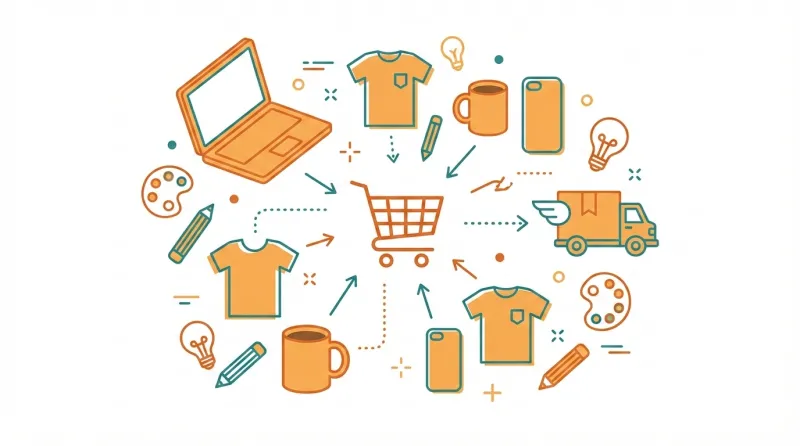
POD Platforms: Which Path Should You Take First?
You have two main routes. The first is a Marketplace (like Redbubble or TeePublic). You upload your design and that's it — the platform has the traffic, handles the sales, and pays you a royalty (typically 10–20%). This is the ideal place to test ideas without spending a cent on advertising.
The second route is your Own Store (Etsy or Shopify + Printful/Printify). Margins are much higher here (you can mark up 50–100%+), but you're responsible for driving your own traffic. In 2026, the most successful sellers combine both approaches: they build their brand on Etsy or their own Shopify store, while treating Redbubble as a fully passive income stream using the same designs.
| Platform | Model Type | Typical Margin | Best For |
|---|---|---|---|
| Redbubble | Marketplace | 10% – 20% | Complete beginners |
| Teespring / Spring | Marketplace + Store | Fixed or % | Social media creators |
| Etsy + Printify | External store | 30% – 60% | Brand builders |
| Shopify + Printful | Own domain | 40% – 100% | Advanced sellers (requires ad budget) |
| Amazon Merch on Demand | Marketplace (invite-only) | 15% – 25% | The holy grail (massive traffic) |
How to Find a Niche That Actually Buys
Mistake number one: making shirts "for dog lovers." That niche is dead — it's too broad. You need to go deeper. "For German Shepherd owners who love mountain biking." That's a niche. The moment someone like that sees a shirt featuring their dog on a bike, they'll think: "That's literally me." And they'll buy without hesitation.
In 2026, the best niches are tied to occupations (nurses, welders, teachers), local pride (specific cities or neighborhoods), and niche hobbies (retro gaming, succulent growing, homebrewing). Use tools like Google Trends and Redbubble's autocomplete search (type a letter and see what the algorithm suggests) to find topics people are searching for where there aren't yet many strong designs. In the US, Society6 and TeePublic also show trending search terms — mine those regularly.

Designing with AI: The POD Revolution in 2026
If you can't draw, I have great news for you. In 2026, the majority of top-selling POD designs are AI-assisted. Tools like Midjourney, DALL-E 3, and Adobe Firefly let you generate stunning graphics in seconds. But here's the catch — you can't just dump a raw AI image onto a shirt. You need to know how to prepare it for print.
The critical steps are background removal and vectorization. For apparel printing, you need a .PNG file with a transparent background at high resolution (minimum 300 DPI). Use tools like Vector Magic or Upscayl to upscale AI-generated artwork without quality loss. Also, don't underestimate typography — often a simple text phrase added in Canva on top of an AI graphic can boost sales by 200%. People love context, and a good tagline delivers it instantly.
💡 Pro Tip: Retro and Vintage Trends
In 2026, the 90s and "bootleg" aesthetic is making a massive comeback. If you can create a design that looks like a faded concert tee from 30 years ago, you have a shot at a big winner. Use "Texture" and "Distress" filters to give your designs that worn-in authenticity that buyers on Etsy and Redbubble consistently go crazy for.
Earnings: How Much Actually Lands in Your Pocket?
Let's get concrete. In POD, revenue figures are vanity — what matters is your profit margin. How much you actually keep after subtracting production costs and platform fees.
On marketplaces like Redbubble, your margin is typically $2–5 per shirt. Sounds small? Remember, you do zero fulfillment work. If you have 1,000 designs and each sells just once a year, that's $2,000–$5,000 in passive income annually. On Etsy, your margin can reach $15–25 per shirt. Selling 100 shirts a month at that rate generates $1,500–$2,500 monthly — a solid side income in any English-speaking market. Scale to 500 units/month and you're looking at a full-time income from designs you created months ago.

Legal: Copyright and Taxes in POD
This is where many beginners blow up their business — they get banned from a platform for copyright infringement. The rule is simple: never use brand logos (Nike, Disney, sports teams) or images of real people without a license. Even if you modify a logo's color by 10%, the platform's algorithms will detect it and suspend your account, often without releasing your earned funds.
🔴 US Tax Obligations for POD Sellers
Selling through POD platforms is taxable income in the US. Platforms like Etsy and Amazon Merch on Demand are required to issue a Form 1099-K if your sales exceed $600 in a calendar year (the threshold lowered significantly in recent years). You'll report this income on Schedule C of your Form 1040. If your net self-employment income exceeds $400, you also owe self-employment tax (15.3%). Consider getting an EIN (Employer Identification Number) from the IRS — it's free and lets you use it instead of your SSN on W-9 forms. For UK sellers, HMRC's £1,000 trading allowance covers small amounts, but above that you'll need to register for Self Assessment. Consult a tax professional if you're scaling past $10,000/year.
POD Creator Toolkit: What You Need to Know
In 2026, tool fluency is your competitive edge. Here's the stack that lets you operate at a professional level:
- Canva Pro: The best tool for fast design work. Always export with "Transparent Background" checked — this is non-negotiable for print-ready files.
- Kittl: A paid (but excellent) Canva alternative built specifically for T-shirt design and logo work. Its typography template library is genuinely impressive and hard to beat for POD-style text effects.
- Photopea: A free, browser-based Photoshop clone. Perfect for final file preparation and masking.
- Creative Fabrica / Vexels: Stock graphic and font libraries with explicit POD commercial licenses. Never use images from a Google image search — ever.
- Placeit: For generating lifestyle mockups — photos of your shirts on real models in real settings. Good lifestyle photos on Etsy can lift conversion rates by 300%, so this tool pays for itself quickly.
Action Plan: Your POD Brand in 30 Days
Stop planning and start doing. Follow these steps:
Days 1–5: Research and Pick 3 Niches
Find 3 niche topics you genuinely understand. Check Redbubble, Etsy, and TeePublic to see what's already there — and more importantly, what's missing or underserved.
Days 6–20: Design Marathon
Create 50 designs. Use AI tools for the base imagery and Canva or Kittl for text overlays. Every design should be available in at least 2–3 color variants to maximize your catalog size.
Days 21–25: Mass Upload
Upload your designs to Redbubble and Teespring/Spring. Focus hard on SEO — titles, descriptions, and tags must match what buyers are actually searching for. Use Redbubble's own autocomplete to guide your tag choices.
Days 26–30: Optimize and Launch on Etsy
Identify your 5 best-performing designs from the marketplaces and list them on Etsy using Printify integration. This is where higher margins and direct customer relationships begin.

FAQ — Everything You Need to Know About Print on Demand
Is the POD model still profitable in 2026?
Yes — but only if you target specific niches. Generic mass-market designs no longer cut through the noise. Buyers are increasingly looking for uniqueness and premium products (organic cotton, eco-friendly inks). Niche down and quality up.
Which print provider do you recommend for US and UK sales?
For the US market, Printful (Charlotte, NC facility) and Printify (with US-based print partners) are both solid choices. For UK buyers, both have EU/UK fulfillment options that reduce shipping time to 3–5 days. Gelato is also worth considering — it has a massive global network of local print partners that minimizes shipping times and carbon footprint.
What happens if a customer returns or complains about their shirt?
Most professional print providers (Printful, Printify, Gelato) take responsibility for print defects and damage during shipping. You just need to submit a photo of the issue to their support team, and they'll send a replacement to the customer at no cost to you. For buyer's remorse returns, you'll need to set a clear returns policy in your store — typically "no returns on custom items" is legally and practically defensible.
Can I sell on Amazon Merch on Demand from the US or UK?
Yes, and it's one of the most powerful POD opportunities available. However, Amazon Merch on Demand is invitation-only — you'll need to apply and wait for approval, which can take weeks to months. Once you're in, you gain access to Amazon's enormous customer base with zero advertising spend required. It's the hardest platform to get onto, but arguably the highest-value one in the entire POD ecosystem.
Summary: Your Creativity as a Business
📋 POD Mastery — 10 Golden Rules for Success
- Niche is everything: Don't sell to everyone — sell to someone specific.
- AI design + typography: Combine AI-generated art with a sharp tagline.
- File quality: 300 DPI and transparent background are non-negotiable.
- Diversify platforms: Use Redbubble passively and Etsy actively.
- SEO drives traffic: Your tags must mirror what buyers actually type.
- Zero copyright violations: Protect your account — it's your livelihood.
- Chase trends: TikTok virals and memes translate directly to shirt sales.
- Scale what works: See a design selling? Create 10 variations on that theme.
- Automate everything: Use Printful/Printify integrations so orders process without you.
- Be patient: Building a portfolio that earns around the clock typically takes 3–6 months.
Print on Demand in 2026 is one of the most accessible paths to building a real online business with virtually no startup capital. It's a master class in marketing, design, and data analysis all rolled into one. Whether you want to earn a few hundred extra dollars a month or you're dreaming of building a global apparel brand — POD gives you all the infrastructure you need. The hardest part is your first design and your first sale. After that, it's a game of repetition and optimization. The market is waiting for your ideas. Let's go.
Comments (0)
No comments yet. Be the first!
Add a comment